
Back
Budgeting for a baby in Australia: Costs, leave and a first-year plan
Budgeting for a baby means planning for more than a pram and nappies. Before your due date, work out how parental leave will affect your income, what baby essentials you genuinely need, how much childcare may cost and which government payments you may be eligible for. This guide breaks down the upfront and ongoing costs, so you can build a practical baby budget and feel more prepared for your first year.
🎧 Prefer to listen? Our hosts unpack this article in a podcast episode, exploring the real cost of having a baby in Australia, practical ways to budget for your first year, and how MyBudget helps growing families plan ahead with confidence.
Why budgeting for a baby is essential before you go on maternity leave
Budgeting before parental leave helps you see whether your reduced income will cover household expenses, baby costs and unexpected bills before the income change happens. Before you start shopping, work out what will be coming in, what will be going out and how much you may need to save before baby arrives.
Baby Budget Template
Our free Budgeting Template can help you calculate your parental-leave income gap, organise your baby expenses and see how long your savings may last. It gives you a clearer picture of what you can afford before your household income changes.
Here is what having a baby budget can help you do:
- Plan for baby expenses before the due-date panic sets in
- Understand whether you can afford additional time at home
- Set a realistic savings target before baby arrives.
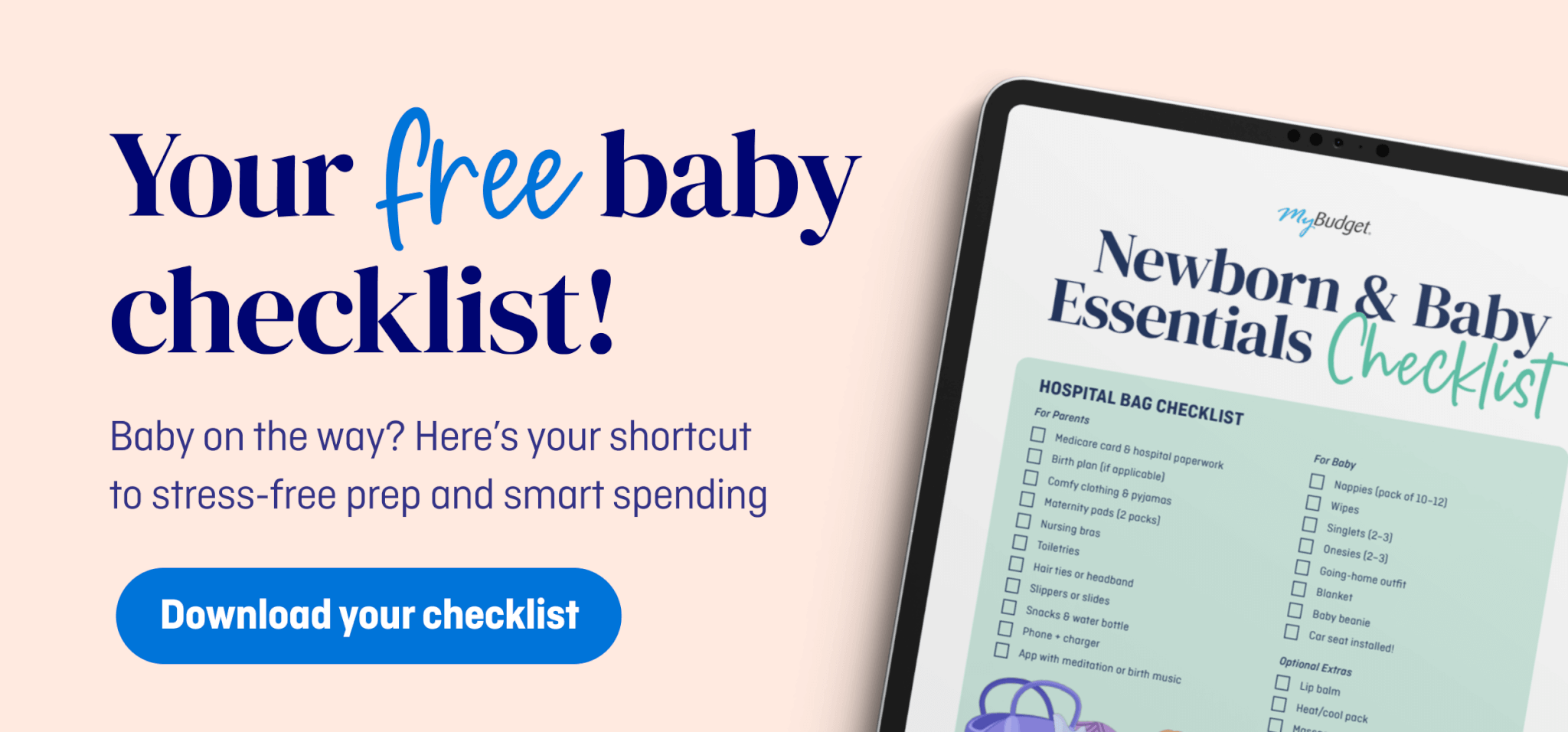
Essential Baby Checklist
We’ve put together a free Newborn & Baby Essentials Checklist that you can download to help plan, budget and prepare. It’s tailored for Australian parents and designed to make shopping easier while avoiding overspending.
What is the cost of having a baby in Australia?
Based on the cost categories in this guide, a practical planning range is roughly $5,000 to $15,000 for baby-only costs in the first year*. Your actual baby expenses will depend on your maternity care, feeding choices, what you buy new and how much your household income changes during parental leave. This range excludes childcare, private maternity care and any gap between Parental Leave Pay and your usual income.
Before baby arrives, you’ll need to plan for upfront costs such as a car seat, pram, cot and feeding equipment, as well as ongoing expenses including nappies, formula or baby food, healthcare and clothing. We break these costs down below so you can create a realistic baby budget without feeling as though you need to buy everything at once.
Pregnancy and birth costs are separate from this baby-only planning range. Out-of-pocket costs can differ significantly depending on whether you use Medicare-supported public maternity care or choose private maternity care, so check your likely hospital, obstetrician and health insurance costs separately.
*How we calculated this: Estimate is based on upfront and ongoing baby costs in this guide. This is not a national average and excludes childcare, private maternity care, and income gaps from Parental Leave Pay, so actual first-year costs may vary.
Can I afford a baby? The real financial impact
For many families, affording a baby is less about the total cost and more about managing cash flow when income drops and monthly expenses increase. The biggest changes are usually parental leave, childcare costs, private health or maternity care and the everyday costs of raising a new baby.
If the potential income gap has you holding your breath, you can exhale. Budgeting for a baby early can help you compare your parental-leave income with your household expenses, maximise government support, prioritise essential purchases and work out how much to save before your due date.
If you are planning with a partner, this is also a good time to talk about money before baby arrives and agree on parental leave, childcare, savings and spending priorities.
What upfront baby expenses should you prepare for?
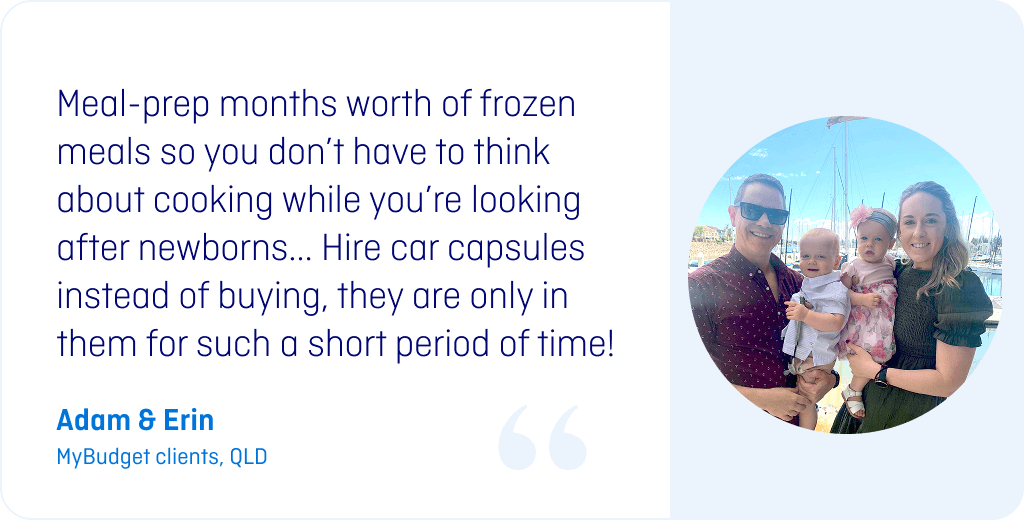
Before splurging on designer babywear or a fully fitted nursery, ask: “Do I really need this?” and “Does it have to be new?” Lower-risk items such as baby clothes, change tables, playmats and nursery storage can often be borrowed, swapped or bought second-hand. You may also be able to hire short-term items, such as an infant capsule, instead of buying something your baby will quickly outgrow.
For safety-critical products, prioritise current safety advice over a bargain. Check applicable Australian safety standards and product recalls before buying a second-hand cot, pram or car restraint. Only use a second-hand car restraint when you can verify its age, condition and full accident history. Read the ACCC’s baby product safety guidance.
How much do essential baby items cost?
To give you a rough guide on baby expenses, we’ve sourced the lowest-to-highest price ranges from Baby Bunting. Of course, you can find deals at low-cost department stores, second-hand marketplaces, or borrow from friends and family to cut costs.
Here are some one-time purchases you can consider before bub arrives:
| Cost area | Example budget range | Plan it this way |
| Car restraint | $250-$800 | Buy new or verify full history |
| Pram or stroller | $250-$2,500+ | Choose for your routine and terrain |
| Cot and mattress | $300-$1,700+ | Prioritise safety, fit and sleep advice |
| Feeding setup | $50-$600+ | Depends on feeding choices |
| Nappies and care | $100-$250 to start | Set a separate monthly amount |
| Clothes and basics | $150-$400 | Buy in small batches |
| Monitor, changing and extras | $150-$1,000+ | Add only if they suit your home |
We used Baby Bunting product categories and price ranges to estimate upfront baby costs. These are indicative only, not official prices or averages – check current pricing before buying.
💡 TIP: consider borrowing, buying second-hand, or swapping with other parents to save hundreds of dollars.
What are ongoing baby expenses? Monthly costs to include in your baby budget
The monthly baby expenses that can really add up are nappies and wipes, feeding, pharmacy items, clothing, transport, private health insurance and childcare. Give each one its own line in your baby budget, rather than relying on a single allowance.
| Monthly cost | Planning range | What can change it |
| Nappies and wipes | $80-$150 | Brand, size and bulk buys |
| Feeding | $0-$300+ | Breastfeeding or formula |
| Clothes and pharmacy | $50-$150+ | Growth and prescriptions |
| Transport and household | $30-$150+ | Driving, laundry and utilities |
| Private health insurance | Varies by policy | Cover, excess and state |
| Childcare | Varies by suburb and CCS | Fee, days and subsidy |
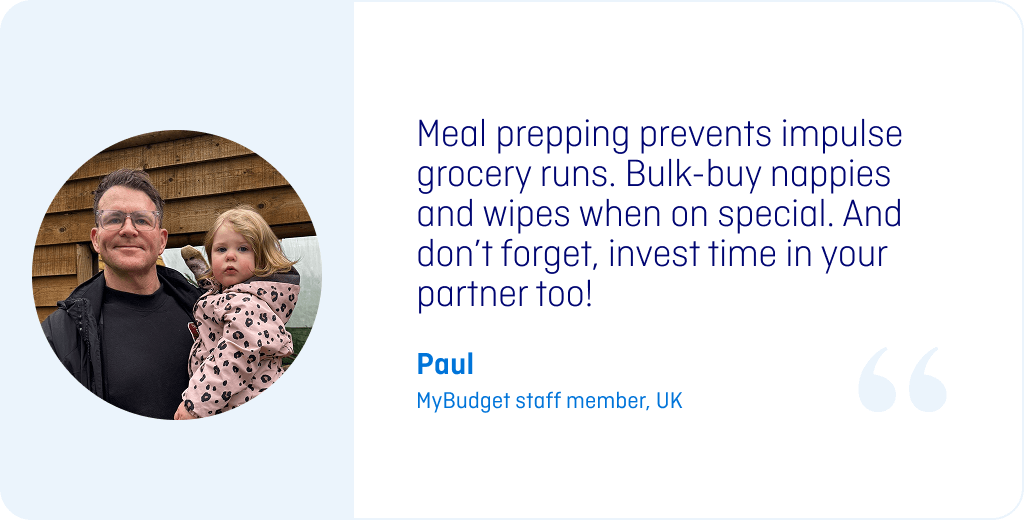
Instead of buying smaller packs of nappies and wipes every week, compare the unit price of bulk packs and buy less often. I usually check retailers such as Big W and Amazon to see who has the better price.
Casey | MyBudget team member
How much does childcare cost in Australia?
Childcare costs in Australia vary widely by suburb, provider, your child’s age, the days you need and the Child Care Subsidy you receive.
How do childcare costs vary by suburb?
Childcare costs can vary dramatically by suburb, your child’s age, the type of care you choose and the days you need. Care for Kids lists a national daily average of $140.68 before subsidies, but some families may pay up to $200 per day or more depending on their location and provider.
If you are returning to work, childcare is one of the biggest costs to plan for. Compare centres near home and work, ask about daily fees, inclusions, waitlists and minimum booking days, then estimate what you will actually pay after the Child Care Subsidy.
💡 TIP: if possible, see if family can help out part-time and also use the free Care for kids calculator to determine the average cost of childcare in your suburb.
Private health insurance for pregnancy: costs, waiting periods and what it covers
If you are planning to use private maternity care, private health insurance usually needs to include pregnancy and birth and be held for at least 12 months before you claim. In Australia, this generally means a Gold hospital policy or a Silver Plus policy that specifically includes pregnancy and birth.
For a family policy, Canstar’s latest research estimates pregnancy cover at about:
- $574 per month for hospital-only cover
- $734 per month for hospital-and-extras cover
Hospital cover can help pay for eligible treatment as a private patient in hospital, including your hospital stay and theatre fees. Extras cover may help with selected services such as physiotherapy, antenatal classes or lactation support, depending on the policy.
However, private health insurance does not automatically cover every pregnancy cost. You may still have out-of-pocket expenses for your obstetrician, appointments, scans, blood tests, anaesthetist, paediatrician and hospital excess. Ask your insurer, chosen hospital and obstetrician for written estimates before deciding.
💡 Tip: compare policies early and check if your chosen hospital and doctor are covered to avoid unexpected out-of-pocket expenses.

What government benefits and paid leave can you get when having a baby?
Depending on your circumstances, you may be eligible for Paid Parental Leave, Family Tax Benefit and the Child Care Subsidy. These payments can help cover income changes, everyday baby expenses and future childcare costs, but eligibility and amounts depend on your income, work history and family situation.
How can you maximise government support
Check what you may be eligible for before baby arrives, keep your income estimate up to date and build the payments into your baby budget alongside any employer-paid leave. Then work through each option below:
Paid Parental Leave (PPL)
- If you are eligible, Paid Parental Leave can help replace part of your income while you care for your new baby. For children born or adopted from 1 July 2026, eligible families can receive up to 130 days, or 26 weeks, of Parental Leave Pay at $1,004.70 per week before tax.
- To meet the work test, you generally need to have worked for at least 10 of the 13 months before your child’s birth or adoption and completed at least 330 hours of paid work during that period. Eligible parents can share their Parental Leave Pay days, so check the rules that apply to your family before adding the payment to your baby budget.
- Parental Leave Pay is taxable. For eligible children born or adopted from 1 July 2025, the Australian Taxation Office will also pay a superannuation contribution on government-funded Parental Leave Pay after the relevant financial year.
- Your employer may offer separate paid parental leave. Check your workplace policy and whether you can use employer-funded leave before, during or after your government-funded Parental Leave Pay.
Family Tax Benefit (FTB)
Family Tax Benefit Part A and Part B are ongoing payments that may help with the cost of raising children. Eligibility and payment amounts depend on your household income, family circumstances and care arrangements, so use Services Australia’s Payment Finder for a current estimate.
Newborn Upfront Payment and Newborn Supplement
If you are eligible for Family Tax Benefit Part A, you may also qualify for the Newborn Upfront Payment and Newborn Supplement. However, you generally cannot receive these payments and Parental Leave Pay for the same child. Services Australia will assess your eligibility when you claim Family Tax Benefit.
Parenting Payment
Parenting Payment is a separate income-support payment for eligible principal carers of young children. Income, assets, relationship status and the age of your youngest child affect eligibility, so use the Services Australia Payment Finder for an individual estimate.
Child Care Subsidy (CCS)
The Child Care Subsidy can reduce the amount you pay for approved childcare. Your subsidy percentage depends on your family income and circumstances, and the payment is generally made directly to your childcare provider.
From 5 January 2026, eligible families can receive at least 72 hours of subsidised childcare per fortnight under the 3 Day Guarantee. Families who meet higher recognised participation requirements may receive up to 100 subsidised hours per fortnight. You will still need to pay any remaining gap fee charged by your provider.
Check the current Child Care Subsidy rules and 3 Day Guarantee before estimating childcare costs in your baby budget.
Child Support Payments: what you need to know
Child support is not a government benefit, but it may form an important part of your household budget if you are separated or co-parenting. The amount paid or received depends on each parent’s income, care arrangements and the assessed costs of raising children.
If child support forms part of your budget, consider how you would cover essential expenses if a payment were delayed or your care arrangements changed. You may also find our guide to managing a family budget on one income helpful.
💡 TIP: If child support is part of your budget, planning independently of these payments ensures financial stability in case circumstances change.
How to extend your parental leave if you’re not ready to return to work
Extending your time at home starts with calculating the gap between your available leave income and your household expenses. Use the months before baby arrives to build a parental-leave savings plan, even if you can only set aside a small amount each week. Planning ahead gives you more choice if you are not ready to return when your paid leave ends.
Here are ways to extend your parental leave:
- Start saving now to cover extra months at home
- Budget strategically with the free Personal Budget Template
- Stagger your return to work with part-time or flexible arrangements where available
- Maximise government payments you are eligible for
- Ask your employer about unpaid parental leave, annual leave or long service leave. Eligible employees can generally take up to 12 months of unpaid parental leave and may request an extension of up to a further 12 months. The extension is not automatic and must follow the relevant notice and approval process. Check Fair Work’s parental-leave extension guidance early.
Op shops are gold for kids’ clothes. They grow out of them so fast, and second-hand finds are often barely worn, perfect for daycare outfits.
Simone | MyBudget team member
How can you save money when having a baby?
You can save money when having a baby by buying only what you will genuinely use, choosing second-hand items where it is safe to do so and planning for costs before they land. The biggest savings usually come from reducing upfront spending, not from trying to cut essentials once baby arrives.
1. Plan for unexpected baby expenses
Set aside a small emergency buffer for surprise medical costs, feeding changes, last-minute baby essentials and replacements. Even the best baby budget needs room for costs you cannot predict. If you do not have a buffer yet, use our guide to build an emergency fund and start with an amount you can manage.
2. Use Facebook Marketplace, buy-sell-swap groups and hand-me-downs
Babies outgrow things quickly, which means you can often find clothing, bassinets, high chairs and playmats for a fraction of the retail price. Check each item carefully and follow current safety guidance. Never compromise on a car restraint’s history, and buy a new mattress where possible.
3. Create a practical baby shower registry
Give friends and family an easy way to contribute to items you will actually use, such as nappies, wipes, bottles, vouchers or a larger item like a pram or cot. Group gifts can reduce your upfront baby expenses without leaving you with duplicates.
Need help planning for a baby?
Having a baby is a huge financial change, but with a realistic budget, smart spending, and the right government support, you can stay home longer and avoid unnecessary money stress.
Want help creating a personalised budget for your growing family? For over 25 years, MyBudget has helped 130,000+ Australians take control of their finances.
Or call us on 1300 300 922.
Budgeting for a Baby FAQs
Can’t find what you’re looking for?
See more FAQs…
Based on the cost categories in this guide, a practical planning range is approximately $5,000 to $15,000 for baby-only expenses in the first year. This excludes childcare, private maternity care and any gap between Parental Leave Pay and your usual income, so your actual costs may be higher or lower.
Having a baby on one income may be possible if your reduced household income can cover housing, bills, baby expenses, debt repayments and a buffer for unexpected costs. Prepare a one-income budget before parental leave begins and test whether your savings and government payments can cover any shortfall.
Start budgeting as early as possible, ideally before pregnancy or as soon as you know you are expecting. This gives you time to estimate first-year baby expenses, understand your parental-leave income, review health insurance waiting periods and build savings before your due date.
Include upfront baby essentials such as a car restraint, pram, cot, mattress and feeding equipment, as well as ongoing costs for nappies, wipes, formula or baby food, clothing, healthcare and transport. You should also budget for childcare, any private maternity-care costs and the gap between your parental-leave income and your usual household income.
Depending on your circumstances, you may be eligible for Parental Leave Pay, Family Tax Benefit, Child Care Subsidy or Parenting Payment. Some families may receive the Newborn Upfront Payment and Newborn Supplement instead of Parental Leave Pay for the same child. Use the Services Australia Payment Finder for an individual estimate.

This article has been prepared for information purposes only, and does not constitute personal financial advice. The information has been prepared without taking into account your personal objectives, financial situation or needs. Before acting on any information in this article you should consider the appropriateness of the information having regard to your objectives, financial situation and needs.