

Back
Is $1 million enough to retire in Australia? How much super you need in 2026

Yes, $1 million may be enough to retire in Australia for many homeowners, but it depends on your lifestyle, housing costs, health, retirement age and how long your savings need to last.
This guide explains how much super you may need in 2026, the latest ASFA retirement benchmarks, and what the new superannuation changes could mean for your retirement savings.
Two people with the same super balance can have very different retirement outcomes. Home ownership, rent, health costs, travel plans, debt and retirement age all affect how far $1 million will stretch.
| 🎧 Prefer to listen? Our hosts unpack this article in a podcast episode, exploring whether $1 million is enough to retire in Australia, the latest 2026 super changes and retirement benchmarks, and how MyBudget can help you build a stronger financial foundation for the future. |
What changed for superannuation on 1 July 2026?
Two changes are especially relevant for Australians building their retirement savings:payday super and the higher concessional contributions cap.
Payday super: super is now paid more frequently
From 1 July 2026, employers are required to make Super Guarantee contributions in line with their employees’ pay cycles rather than relying on the previous quarterly payment schedule.
Under the new rules, employers generally pay super on payday, and contributions must reach the employee’s nominated super fund within seven business days. Some exceptions apply, including extended timeframes for certain new employees.
Why Payday Super Contributions matter
- Your super can be invested sooner, giving it more time to earn returns
- It may be easier to compare your payslip with your super account
- Missing or late contributions should become easier to identify
- It reduces the amount of unpaid super that can accumulate before a problem is detected.
Check your payslip and super account regularly. If a contribution appears to be missing, speak with your employer or payroll team first and contact the Australian Taxation Office if the issue is not resolved.
The concessional contributions cap increased to $32,500
The annual concessional contributions cap increased from $30,000 to $32,500 for the 2026–27 financial year.
Concessional contributions are generally contributions made from income before tax. They include:
- Compulsory employer Super Guarantee contributions
- Salary-sacrifice contributions
- Eligible personal contributions you claim as a tax deduction.
Your employer contributions count towards the cap. If you salary sacrifice or make deductible personal contributions, check your total contributions before adding more, as exceeding the cap may result in additional tax.
The Super Guarantee rate remains 12%
The compulsory Super Guarantee rate reached 12% on 1 July 2025 and remains at 12% for 2026–27. Payday super changes when employer contributions are paid; it does not increase the percentage itself.
How much super do I need to retire in Australia?
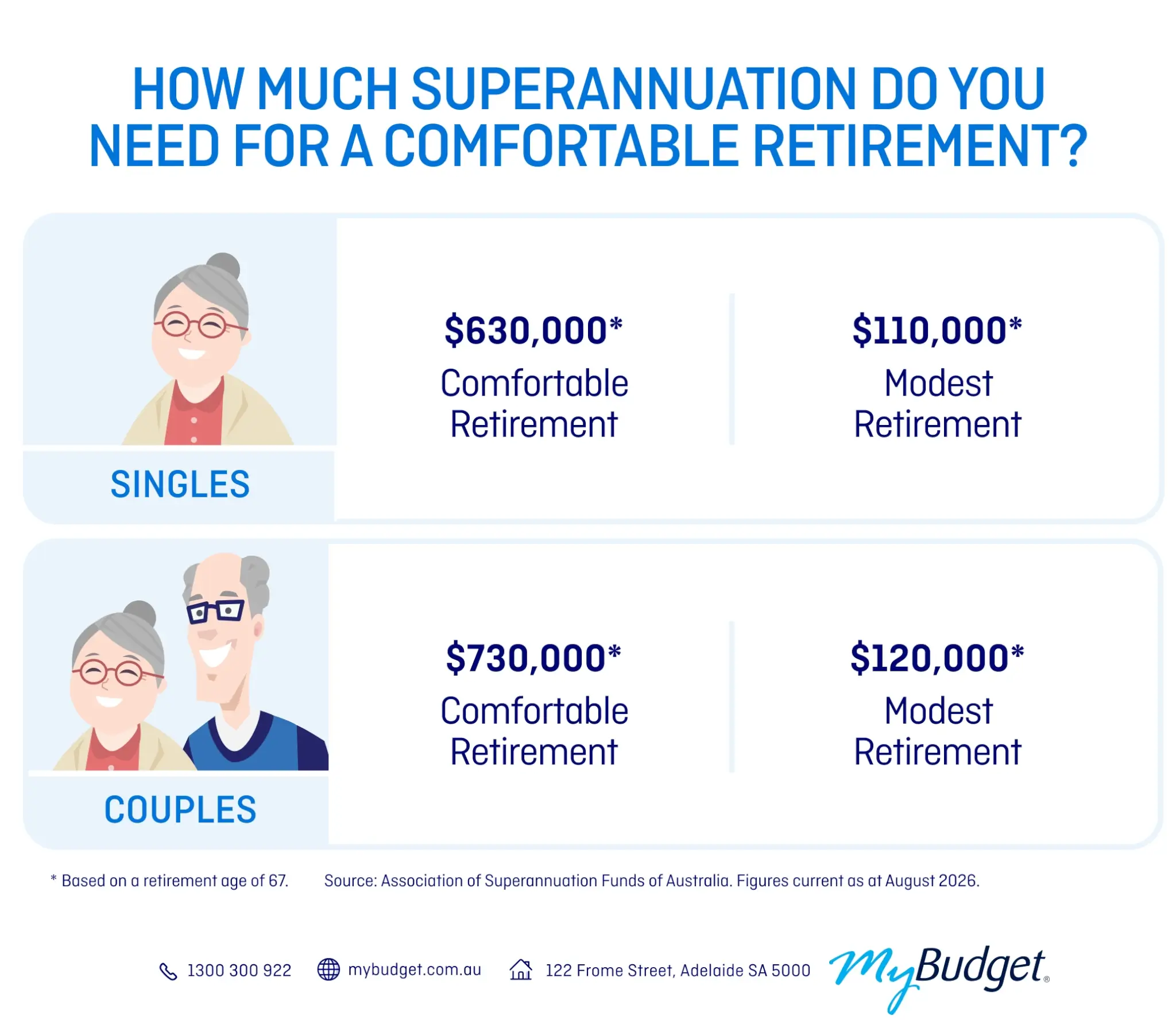
The Association of Superannuation Funds of Australia (ASFA) estimates that homeowners retiring at age 67 need approximately:
- $630,000 for a single person seeking a comfortable retirement
- $730,000 for a couple seeking a comfortable retirement
- $110,000 for a single person seeking a modest retirement
- $120,000 for a couple seeking a modest retirement.
These estimates assume retirees draw down their savings over time and receive at least a part Age Pension. They are useful planning benchmarks, not personalised financial targets.
Renters generally need substantially more because housing costs continue throughout retirement. ASFA estimates that a modest retirement for private renters requires around $340,000 for a single person or $385,000 for a couple.
When $1 million may or may not be enough
For many homeowners, $1 million in super and retirement savings could support a comfortable retirement. It is above ASFA’s current comfortable-retirement benchmarks of $630,000 for a single homeowner and $730,000 for a homeowner couple.
However, $1 million may not be enough if you:
- Retire well before age 67
- Expect to rent throughout retirement
- Plan frequent or expensive travel
- Have substantial health or aged-care costs
- Want to support adult children or other relatives
- Expect your savings to last for 30 years or more
- Carry a mortgage or other debt into retirement.
Investment returns, inflation, fees and the rate at which you withdraw money will also influence how long your savings last. Consider modelling several scenarios rather than relying on one headline number.
How much annual income does a comfortable retirement require?
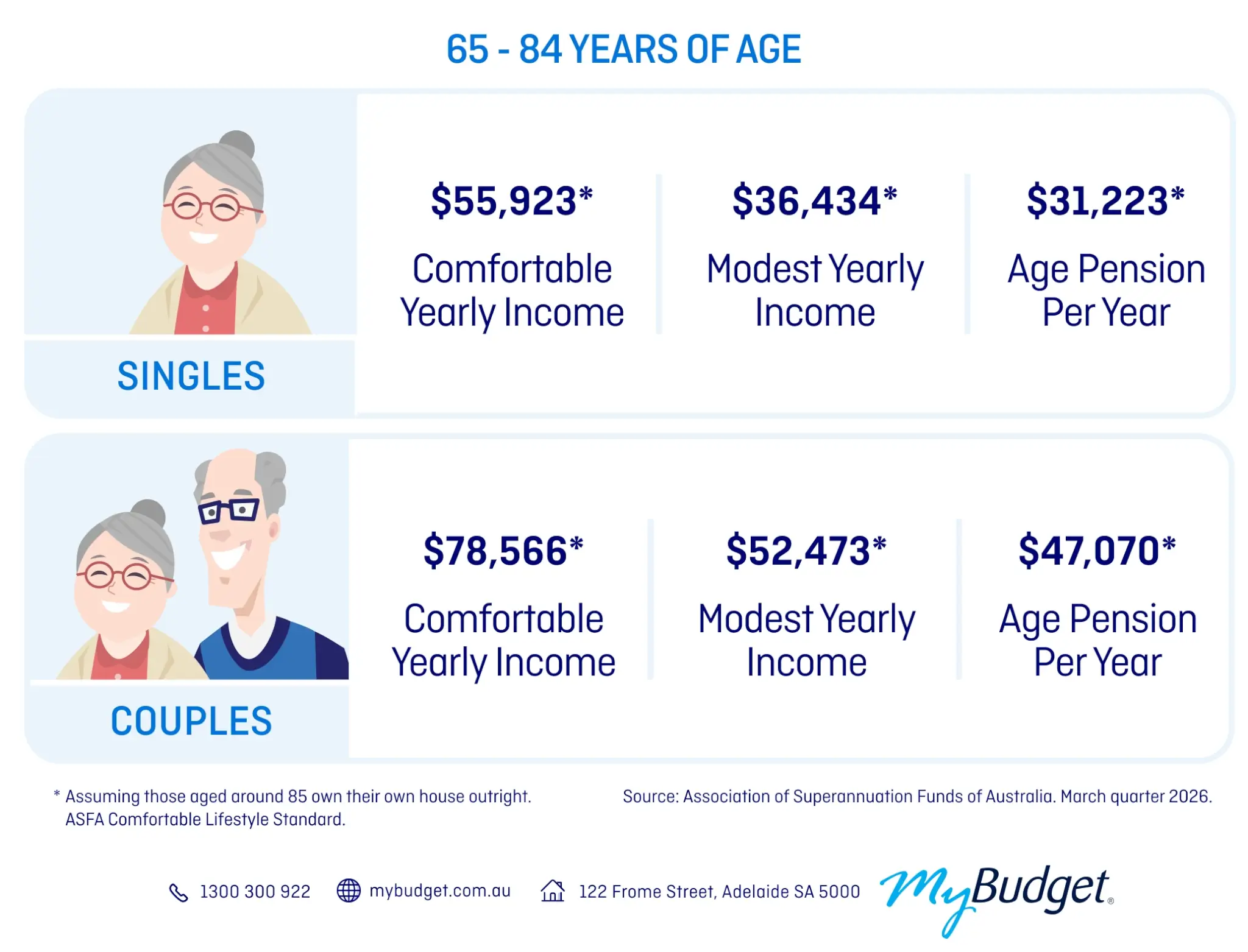
ASFA’s March quarter 2026 Retirement Standard estimates the following annual budgets for retirees aged 65–84 who own their home outright:
- Single comfortable lifestyle: $55,923 a year
- Single modest lifestyle: $36,434 a year
- Couple comfortable lifestyle: $78,566 a year
- Couple modest lifestyle: $52,473 a year.
The maximum Age Pension amounts used in the same comparison are $31,223 a year for a single person and $47,070 a year for a couple, including supplements. The amount an individual receives depends on income, assets, relationship status and other eligibility rules.
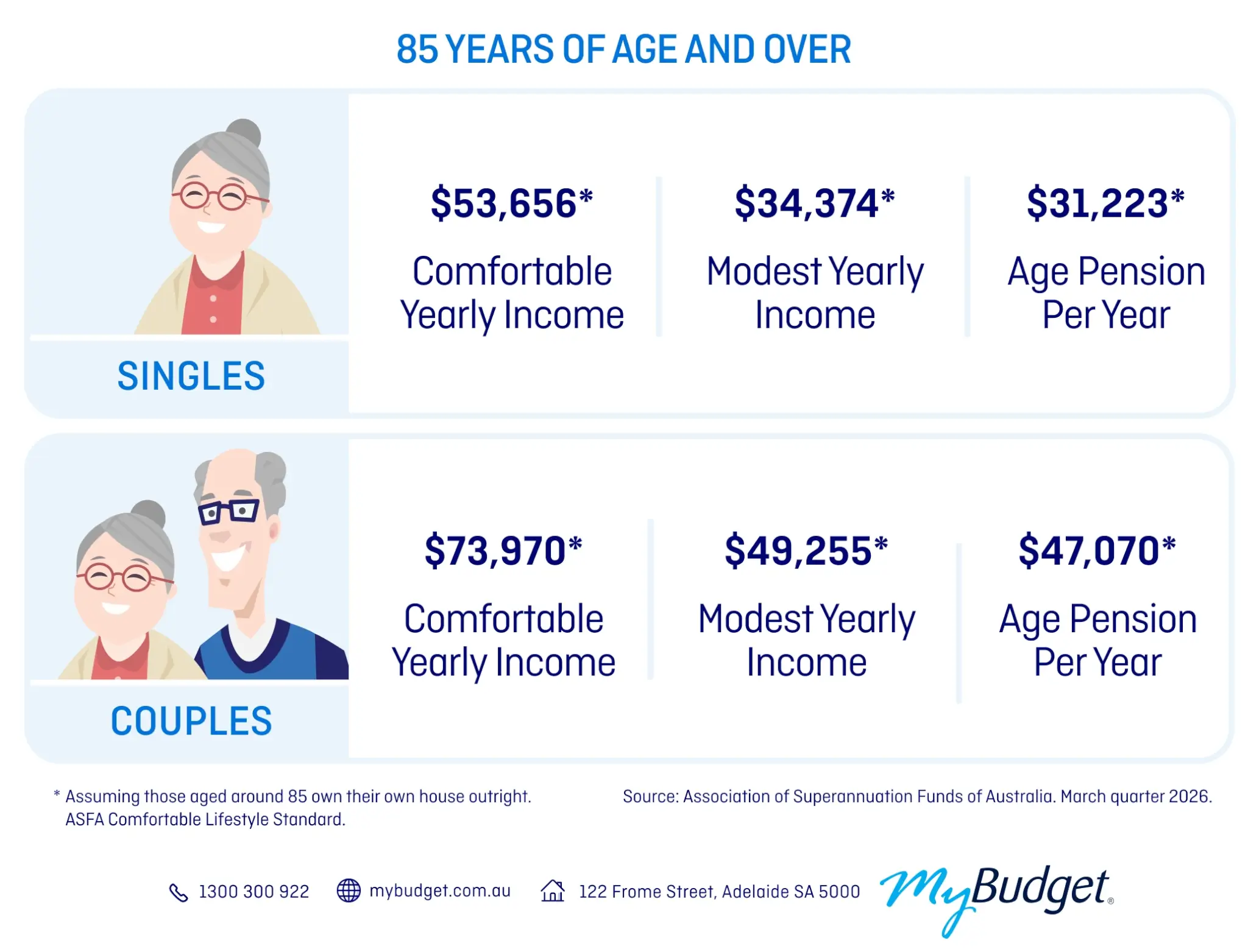
For retirees aged over 85, ASFA estimates:
- Single comfortable lifestyle: $53,656 a year
- Single modest lifestyle: $34,374 a year
- Couple comfortable lifestyle: $73,970 a year
- Couple modest lifestyle: $49,255 a year.
What does a comfortable retirement really mean?
ASFA describes a comfortable retirement as one that supports more than the basic essentials. It may include:
- Comprehensive private health insurance and out-of-pocket healthcare
- Reliable internet, devices and streaming services
- Regular leisure activities and meals out
- Domestic holidays and occasional overseas travel
- Home repairs, maintenance and replacement appliances
- The ability to replace a car when needed.
A modest retirement covers essential living expenses with a smaller allowance for discretionary spending, entertainment and travel. Even a modest budget may be difficult for private renters because ASFA’s standard homeowner figures assume the home is owned outright.
How does your super balance compare?
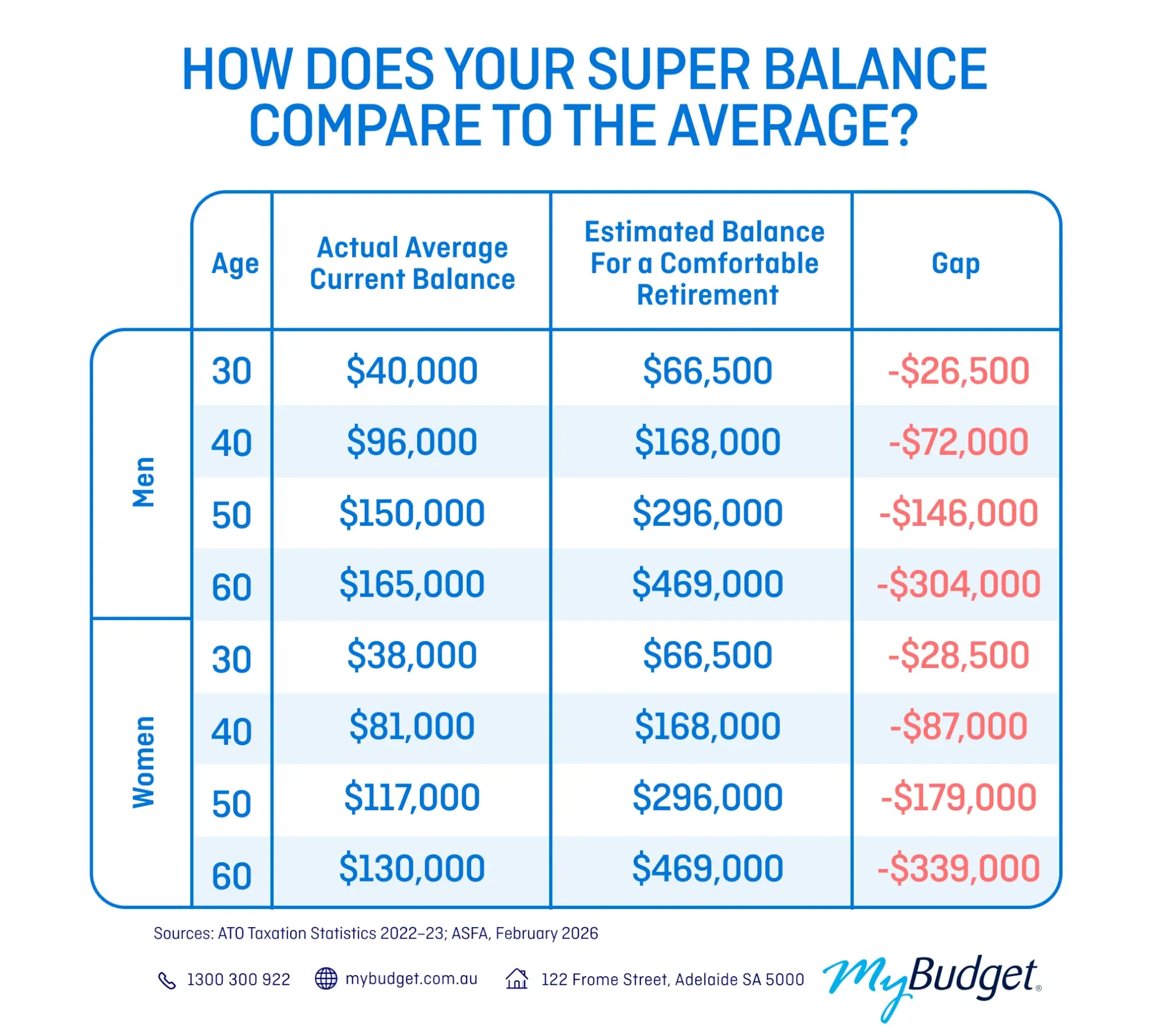
The latest ATO data available for this comparison, covering super balances at June 2023, show substantial differences across age groups and between men and women.
Median balances for men:
- Age 30: $41,268
- Age 40: $108,344
- Age 50: $177,194
- Age 60: $219,773.
Median balances for women:
- Age 30: $36,016
- Age 40: $79,445
- Age 50: $122,150
- Age 60: $163,218.
ASFA’s suggested balances for someone aiming to be on track for a comfortable retirement at age 67 are:
- Age 30: $66,500
- Age 40: $168,000
- Age 50: $296,000
- Age 60: $469,000.
These suggested milestones assume future pre-tax income of $65,000 a year that increases with inflation. They are general estimates and should not be treated as personalised advice.
The comparison also highlights the gender super gap. Career breaks, caring responsibilities, part-time work and differences in lifetime earnings can all affect the amount accumulated by retirement.
What if I do not have enough super to retire?
If your balance is below the suggested benchmarks, you are not alone. The most useful response is to understand your position early and focus on the actions available to you.
Review your super fund
Compare fees, long-term performance, insurance and investment options. A small difference in annual fees or returns can have a large effect over several decades.
Find and consolidate lost super
Check whether you have multiple or lost super accounts. Consolidating may reduce duplicate fees, although you should review insurance and other benefits before closing an account.
Consider additional contributions
Depending on your circumstances, options may include salary sacrifice or personal deductible contributions. Even modest regular contributions can build over time through compound returns.
Check whether you can use carry-forward contributions
Eligible people with a total super balance below the relevant threshold may be able to use unused concessional cap amounts from earlier financial years. Check your available amount through ATO online services before contributing.
Review your investment strategy
Your investment option should reflect your time horizon, goals and comfort with risk. Avoid making rushed changes based only on short-term market movements.
Reduce expensive debt
Entering retirement with high-interest debt or a large mortgage can place extra pressure on your savings. A realistic debt-reduction plan may be just as important as increasing your super. If your home loan is likely to continue into retirement, explore these practical ways to pay off your mortgage faster.
Plan for your housing costs
Home ownership has a major influence on retirement affordability. If you expect to rent, use a retirement budget that includes realistic future housing costs rather than relying on homeowner benchmarks.
What is the Age Pension and when can I access it?
The Age Pension provides income support to eligible Australians who have reached Age Pension age, currently 67.
Eligibility is determined through Services Australia’s income and assets tests. Your home is generally treated differently from other assets, which is one reason home ownership can significantly affect retirement outcomes.
The Age Pension can form part of a broader retirement-income plan alongside super, savings and investments. The maximum published rate is not necessarily the amount you will receive.
How does inflation affect retirement savings?
Inflation reduces purchasing power, meaning the same amount of money buys less over time. With the cost of living in Australia continuing to place pressure on household budgets, even moderate inflation can significantly change the amount needed for food, energy, healthcare, insurance and housing over a retirement lasting 20 or 30 years.
That is why retirement planning should be reviewed regularly. Your target should move as your circumstances and living costs change rather than remaining fixed for decades.
When should I start planning for retirement?
The earlier you begin, the more time you have to benefit from compound returns and make gradual adjustments. A personal budget can help you understand your current cash flow and identify how much you may be able to direct towards savings, debt reduction and long-term goals.
Start by:
- Checking your current super balance
- Reviewing fees, insurance and investment options
- Estimating the lifestyle and housing costs you expect
- Identifying debts you want to repay before retirement
- Reviewing your budget and contribution strategy regularly.
Ready to put the numbers on paper? Download MyBudget’s free Personal Budget Template to organise your income, expenses and savings goals in one place.

How can MyBudget help me prepare for retirement?
MyBudget helps Australians build realistic budgets, manage bills, reduce debt and save towards long-term goals.
Our Money Coaches can help you:
- Understand where your money is going
- Build a personalised budget
- Develop a plan to reduce debt
- Create regular savings habits
- Improve visibility over upcoming expenses
- Balance current lifestyle needs with future goals.
MyBudget does not provide personal superannuation or investment advice. However, getting your everyday finances under control can create a stronger foundation for retirement planning.
For over 25 years, we have helped more than 130,000 Australians get ahead and stay ahead.
Ready to create more room in your budget for your future?
Or call 1300 300 922 to find out how MyBudget can help.

Retirement & Superannuation FAQs
Can’t find what you’re looking for?
See more FAQs…
ASFA estimates that a single homeowner needs around $630,000 and a homeowner couple needs around $730,000 at age 67 for a comfortable retirement. Your personal target may be higher or lower depending on housing, lifestyle, health, retirement age and other income.
It may be enough for many homeowners, particularly when combined with Age Pension eligibility. However, early retirement, renting, substantial travel, debt or high healthcare costs may increase the amount required.
Payday Super Guarantee requires employers to make Super Guarantee contributions in line with employees’ pay cycles. It is intended to help contributions reach super funds sooner and make missing payments easier to identify.
The concessional contributions cap is $32,500 for 2026–27. Employer Super Guarantee payments, salary-sacrifice amounts and eligible personal contributions claimed as a tax deduction all count towards it.
ASFA reported an average Australian super account balance of $172,834 in October 2025. However, balances vary considerably by age and gender, and median figures can be more representative because very high balances lift the average. General benchmarks are not personalised targets.
MyBudget does not provide superannuation or investment advice. We can help you build a budget, manage bills, reduce debt and create savings capacity, which may make it easier to work towards your long-term goals.
This article has been prepared for information purposes only, and does not constitute personal financial advice. The information has been prepared without taking into account your personal objectives, financial situation or needs. Before acting on any information in this article you should consider the appropriateness of the information having regard to your objectives, financial situation and needs.