
How to set up a budget
6 min read

Every year around June and July, Australians are bombarded with the same seasonal advice: organise your receipts, maximise your deductions, and secure your tax refund.
But after more than 25 years of helping Australians take back control of their money, I have noticed something interesting.
The people who make the most profound, lasting improvements to their finances aren’t necessarily the ones who walk away with the biggest tax refund.
Instead, they are the ones who shift their focus toward building daily money habits, setting aside a secure financial buffer, and putting a structured, 12-month system in place. This works because long-term stability rarely comes from a once-a-year windfall, it is built on the steady, consistent choices that create real momentum over time.
While a tax refund might give you a temporary boost for a few weeks, building better money habits is the real financial reset you need. It is an opportunity to pause, look ahead with clarity, and make a few intentional changes before stepping into a new financial year.
If you are ready to make that shift, these are the five simple money moves I recommend starting with today.
The best money moves to make at the start of a new financial year are reviewing your spending, reducing unnecessary expenses, strengthening your emergency fund, conducting a financial health check and setting one clear financial goal for the year ahead.
Focusing on these simple money habits can help you feel more confident, more prepared and more in control of your money.
Let’s take a closer look at each of these money moves and why they matter.
If you have ever reached the end of the month, looked at your bank account, and wondered where on earth all your money has gone, you are absolutely not alone. It is an incredibly common source of frustration, but it is rarely a reflection of your discipline.
Over the course of a busy year, everyday habits naturally drift. Subscriptions creep in, utility costs rise, and convenience spending quietly becomes a daily routine. In a world of automatic, tap-and-go payments, we are forced to make dozens of unconscious financial decisions every single week. This leads to decision fatigue, where the friction-free ease of modern spending simply outpaces our conscious awareness of it.
The most empowering way to break this cycle is to start by looking backward with curiosity, not judgment. Spend half an hour conducting a budget review. Log into your banking app, download your statements, and look closely at your recurring payments over the last few months to identify where your costs have shifted.
Look specifically for quiet financial leaks. It is incredibly common to find streaming platforms, apps, or memberships that you have completely forgotten about. If subscription drift is draining your account, reading our guide on how to stop subscription creep can help you identify and plug those gaps quickly.
One of the most powerful steps in any budget review is simply becoming aware of where your money is really going.
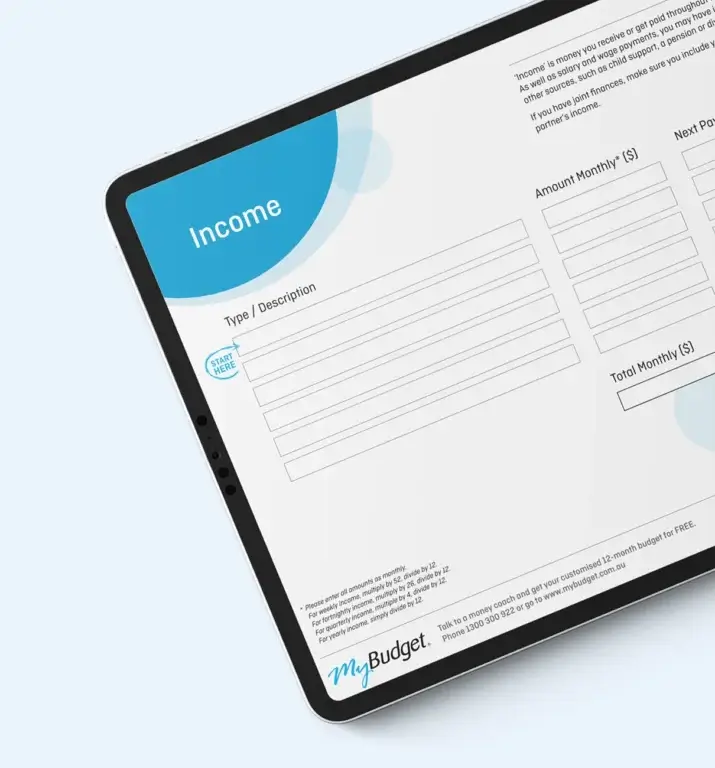
To make this step as easy as possible, you can map out your income and fixed commitments using our free Personal Budget Template.
We often talk about physical health check-ups, but very few people take the time to check in on their financial wellbeing.
Ask yourself these five simple questions:
There are no right or wrong answers here, and the goal is certainly not perfection. The goal is to bring these worries into the light so they lose their power.
What is financial wellbeing? Financial wellbeing is your practical ability to comfortably meet your current financial commitments, absorb unexpected life expenses, and make intentional progress toward your long-term life goals.
When we look at the data from our recent MyBudget 2026 Client Survey of 741 everyday Australians, the impact of moving from financial chaos to structured support is clear.
Our survey found that 92.6% of clients reported significantly reduced financial stress after establishing their budget plan.
Even more profoundly, 87% of clients reported sleeping better at night knowing their finances were taken care of. Financial wellbeing isn’t just about numbers; it’s about reclaiming your mental capacity and securing your peace of mind.
Many people avoid looking at their household budget because they assume that getting ahead requires making massive, painful sacrifices. They dread the idea of cutting out every small joy, like their weekend coffee or dinners with friends, and end up doing nothing at all because the alternative feels too restrictive.
We are conditioned to think about saving in extremes, but willpower is a finite resource. Attempting to restrict your lifestyle too severely almost always leads to fatigue and an eventual blowout. In reality, some of the best, most sustainable financial wins don’t come from cutting out your lifestyle; they come from renegotiating your fixed bills.
I want you to choose just one recurring household expense this week and see if you can reduce or renegotiate it.
Start with these key areas:
According to our 2026 MyBudget Client Survey, when Australians face cost-of-living pressures, the most common areas they adjust are discretionary expenses: dining out (66.4%), entertainment (59.8%), and travel (51.3%). However, by actively auditing your fixed bills instead of just sacrificing your social life, you can create ongoing breathing room without feeling restricted.
Even saving an extra $20 or $30 a week from a household bill audit adds up to more than $1,000 over a year. To help you negotiate with your providers, download our free Get a Better Deal Checklist to guide your conversations and secure immediate savings.
If the past few years have taught us anything, it’s that life rarely goes exactly according to plan. Your car breaks down, an appliance suddenly fails, a medical bill arrives, or employment circumstances change.
When you don’t have a financial buffer, these everyday inconveniences quickly snowball into major financial crises. It creates a stressful cycle of relying on high-interest credit cards, buy now play later (BNPL) services, or personal loans just to get through to the next payday, keeping you stuck in a reactive loop.
An emergency fund changes everything. It acts as your financial shock absorber, turning potential crises into manageable inconveniences. If you don’t have an emergency fund yet, please don’t be discouraged. Start small. Even a $500 buffer can completely transform how you react to an unexpected expense.
Our latest MyBudget client data reveals a striking shift in savings behaviour. Before joining MyBudget, 82.7% of our clients had less than $500 in savings, essentially living paycheck to paycheck. After implementing a structured budgeting system, 53.3% of those same clients now confidently hold a secure emergency buffer of over $1,000.
If you are ready to start building your safety net, you can calculate your savings path using our free Savings Goal Calculator or explore our practical step-by-step guide on how to build an emergency fund.
An emergency fund won’t make you wealthy overnight, but it can give you something just as valuable: peace of mind when life throws you a curveball.
Tammy Barton | MyBudget, Founder & Director
One of the most common mistakes I see people make at the start of a new financial year is trying to tackle too many major goals at once. They want to pay off all their credit card debt, save for a home deposit, book a holiday, renovate the kitchen, and invest in the market simultaneously.
Trying to split your focus across five different directions at once creates cognitive overload. When progress is slow across all areas, it’s easy to feel overwhelmed, lose momentum, and give up entirely because the mountain feels too steep to climb.
Instead of scattering your energy, choose one highly meaningful goal for the next 12 months.
What is the single change that would bring the most relief to your life right now?
A single, clear goal creates intense focus, and focus is what builds momentum.
You can use our free Goal Setting Template to define your target, break it down into bite-sized milestones, and track your progress throughout the year. Remember, the people who get ahead financially aren’t always the ones earning the highest incomes. More often, they are the ones who consistently direct their resources toward a clear destination.
Tax time tends to dominate financial conversations in June and July. But long-term financial wellbeing is built on something far more sustainable than a once-a-year refund.
It is built on habits: knowing where your money goes, making intentional decisions, planning ahead, and taking small steps consistently over time.
Building these habits takes time, which is why having a structured system is so important. In fact, our clients report saving an average of 2.14 hours every single week after outsourcing their bill payments and financial administration to MyBudget. That is equivalent to claiming back 4.6 days every single year to spend on the things and people you love.
The end of the financial year isn’t just a deadline. It’s an opportunity to pause, reflect, and decide where you want your money to take you next.
Tammy Barton | MyBudget, Founder & Director
The most meaningful financial progress rarely comes from a single event. It comes from the choices you make every day.
If you are looking for a financial reset, don’t wait for the “perfect” moment.
Start today. Review your spending. Check in on your financial wellbeing. Audit one household bill. Add a small contribution to your emergency fund. Write down your one single financial goal.
None of these moves are complicated. But when you combine them, they give you the structure, confidence, and peace of mind you need to step into the new financial year in complete control.
The best time to improve your finances isn’t June 30.
It’s the very moment you decide to take control of what’s next.
Ready to reduce your mental load and see exactly what you can achieve with your money over the next 12 months? Book a free, no-obligation appointment with a MyBudget Money Coach today and let us help you design a customised, stress-free money plan built for real life.
Or call us on 1300 300 922.
Can’t find what you’re looking for?
See more FAQs…
If you only do one thing, review where your money has gone over the past 12 months. Understanding your spending habits helps you identify opportunities to save, reduce unnecessary expenses and make more informed financial decisions.
Improving financial wellbeing starts with understanding your financial position, building an emergency fund, reducing financial stress and setting achievable goals. Small, consistent actions often have a greater long-term impact than dramatic financial changes.
The best option depends on your circumstances. If you have high-interest debt, paying it down may save you money over time. If you have little or no emergency savings, building a financial buffer may provide greater peace of mind and financial security.
An emergency fund helps cover unexpected expenses such as car repairs, medical costs or temporary income disruptions. Having savings available can reduce financial stress and prevent reliance on credit cards or loans.
This article has been prepared for information purposes only, and does not constitute personal financial advice. The information has been prepared without taking into account your personal objectives, financial situation or needs. Before acting on any information in this article you should consider the appropriateness of the information having regard to your objectives, financial situation and needs.