Back
What can I claim on my tax return in Australia? | A 2026 guide
Wondering what you can legally claim on your 2026 Australian tax return? This guide explains tax deductions, ATO rules, receipts, tax rates, offsets, deadlines, and the tax changes Australians need to know before lodging.
Between TikTok “tax hacks”, changing ATO rules, and that growing pile of receipts shoved into your glovebox or kitchen drawer, tax time can feel a little chaotic.
The good news? Understanding your Australian tax return doesn’t have to be complicated.
This guide breaks down what you can claim, what you can’t, what the Australian Taxation Office (ATO) is watching closely in 2026, and the tax changes Australians need to know before lodging.
At MyBudget, we’re not tax agents, and we don’t prepare or lodge tax returns. |
What can I claim on my tax return in 2026?
You can generally claim expenses that directly relate to earning your income, as long as you paid for them yourself and kept records to prove it.
Some of the most common tax deductions Australians claim include:
- Work-related car and travel expenses
- Work-from-home expenses
- Uniforms and protective clothing, including eligible laundry expenses
- Mobile phone and internet costs
- Tools, laptops, printers and work equipment
- Self-education expenses
- Union fees and professional memberships
- Eligible charitable donations to registered deductible gift recipients
- Stand alone Income protection insurance premiums – not premiums inside superannuation.
| For a deeper breakdown of work-related deductions, including occupation-specific examples, see our full work-related deductions guide. |
The ATO’s 3 golden rules for tax deductions
Before you claim anything on your tax return, the expense needs to pass the ATO’s three golden rules.
1. The expense must relate to earning your income
There needs to be a direct connection between the expense and your job.
For example:
- A nurse buying scrubs may be eligible
- A tradie purchasing safety boots may be eligible
- A teacher completing a work-related course may be eligible.
But everyday clothing, personal grooming, or your morning coffee usually won’t cut it.
2. You must have paid for it yourself
If your employer reimbursed you, you generally can’t claim it.
3. You need records to prove it
Receipts, invoices, bank statements, logbooks, or diary records matter.
Pro tip: the ATO app lets you photograph and store receipts throughout the year, so you’re not trying to decode faded servo receipts and mystery Officeworks purchases in June.
The ATO increasingly uses data matching and automation to compare claims against industry averages, so keeping proper records is more important than ever.
Australian income tax rates for 2025–26
Your marginal tax rate is the percentage of tax you pay on each additional dollar you earn.
Understanding your tax bracket can help you:
- Estimate your tax refund
- Prepare for side hustle income
- Understand HECS/HELP impacts
- Plan super contributions
- Avoid surprise tax bills.
| Taxable income | Tax payable |
|---|---|
| $0 – $18,200 | Nil |
| $18,201 – $45,000 | 16c for each $1 over $18,200 |
| $45,001 – $135,000 | $4,288 + 30c for each $1 over $45,000 |
| $135,001 – $190,000 | $31,288 + 37c for each $1 over $135,000 |
| $190,001 and over | $51,638 + 45c for each $1 over $190,000 |
The above rates do not include the Medicare levy of 2%.
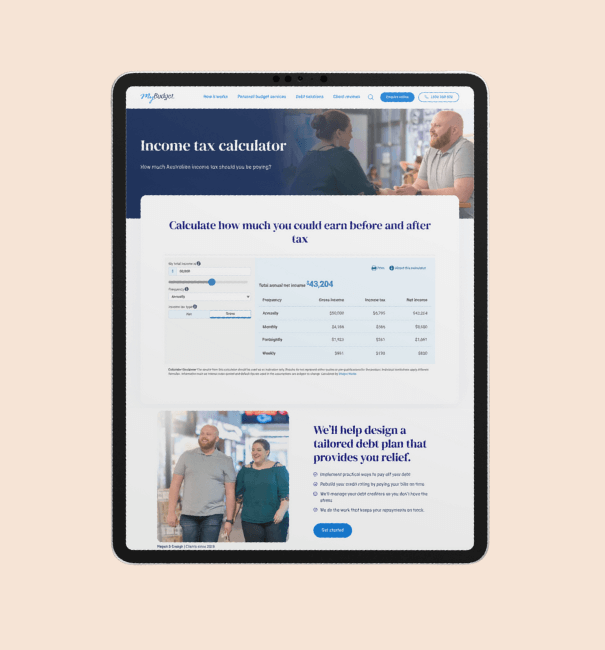
Want a quicker estimate? Try our free Income Tax Calculator to get a rough idea of how much tax you may pay based on your income. |
What is the Medicare levy?
The Medicare levy is a separate tax most Australians pay to help fund Australia’s public health system. It’s 2% of your taxable income and is added to your total tax payable at tax time.
Most Australians pay the Medicare levy, although some lower-income earners, eligible seniors and pensioners, and people who meet specific exemption criteria may pay a reduced rate or nothing at all.
What is the Medicare levy surcharge?
The Medicare levy surcharge is an extra charge on top of the standard 2% Medicare levy.
If you don’t have eligible private hospital cover and your income is above the ATO threshold, you may pay an additional 1% to 1.5%.
For the 2025–26 tax year, the surcharge generally applies if your income is above:
- $97,000 for singles
- $194,000 for families.
The exact rate depends on your income bracket.
This can reduce your expected tax refund if you haven’t factored it in.
Are the new tax cuts, offsets and deductions available in the 2025–26 tax return?
No. The recently announced Federal Budget tax changes do not apply to the 2025–26 tax return covered in this guide.
That includes:
- $268 tax cut: Lower personal income tax rates for eligible Australians from 1 July 2026
- $1,000 instant deduction: A proposed simplified work-related deduction without needing receipts
- $250 tax offset: A proposed Working Australians Tax Offset for a later financial year, alongside other offset changes.
| These changes are expected to apply from the 2026–27 financial year onward, not the 2025–26 tax return covered in this guide, subject to legislation. Want the full breakdown? Read our Federal Budget 2026 guide to see what’s changing for Australian households. |
What work-related expenses can I claim?
Work-related expenses are one of the most commonly claimed tax deduction categories in Australia.
You may be able to claim eligible expenses such as:
| Expense category | Usually claimable? | Notes |
| Travel between job sites | Yes | Daily commute usually not claimable |
| Work-from-home expenses | Yes | Records required |
| Uniforms and protective gear | Yes | Must be occupation-specific or compulsory |
| Tools and equipment | Yes | Depreciation may apply |
| Mobile phone and internet | Partly | Work-related portion only |
| Self-education | Sometimes | Must relate to your current role |
| Meals and coffee | Usually no | Limited exceptions apply |
| Everyday clothing | No | Even if only worn to work |
| Work-related deductions are where many Australians get tripped up, especially with work-from-home claims, vehicle expenses, and phone or internet use. For a full breakdown of what’s actually claimable, see our work-related tax deductions guide. |
What tax deductions can I claim without receipts?
There are some situations where Australians can claim certain deductions without formal receipts, but there are limits.
Common no-receipt tax deduction rules
| Deduction type | Potential written evidence threshold |
| Work-related expenses | Up to $300 |
| Laundry expenses | Up to $150 |
| Cents per kilometre car claims | Up to 5,000km at 88c per kilometre |
Even without receipts, you still need to show:
- You actually spent the money
- The expense relates to your work
- How you calculated the claim.
Bank statements, diary notes, rosters, and logbooks can all help support your claim.
What can’t I claim on tax?
Not every expense that feels work-related is actually tax deductible.
The ATO has strict rules around personal expenses, commuting, and claims that don’t directly relate to earning your income.
Common expenses Australians generally can’t claim
- Travel from home to your regular workplace
- Gym memberships
- Personal grooming and grooming products
- Coffee, lunches and everyday meals
- Childcare and school fees
- Everyday clothing
- Entertainment and social expenses
- Income protection insurance premiums inside superannuation
- Expenses your employer reimbursed.
If something feels questionable, it’s worth checking the ATO rules before lodging.
Common tax deduction mistakes the ATO is watching in 2026
The ATO increasingly uses data matching, automation, and compliance monitoring to identify unusual claims.
That doesn’t mean honest taxpayers should panic, but it does mean inflated deductions, undeclared income, poor record keeping, and copy-paste claims are much riskier than they used to be.
The ATO continues to closely monitor several common tax return problem areas.
Work-related expense overclaiming
Claims that seem unusually high compared to your occupation may trigger review.
Incorrect work-from-home claims
The ATO is closely checking:
- Hours worked from home
- Fixed-rate calculations
- Record keeping.
Side hustle and gig income
One of the most commonly forgotten tax issues is additional income outside your main job.
Income from the following still needs to be declared to the ATO, even if it feels irregular or secondary:
- Uber or rideshare work
- Airtasker
- Freelancing
- Online selling
- Content creation
- Bank interest
- Dividends and investment income.
- Copy-and-paste deductions from previous years
Reusing last year’s claims without records is a common mistake.
Expert EOFY tax tips from Tammy Barton and Craig Whiteman from EY
Tax time can feel overwhelming, especially when rules shift, headlines scream about deductions, and social media suddenly turns everyone into a tax expert.
To help cut through the noise, MyBudget Founder and Director Tammy Barton sat down with Craig Whiteman from EY to talk through practical EOFY tax tips, common mistakes, and what Australians should really be focusing on.
This conversation is general educational information only. MyBudget does not prepare or lodge tax returns, but we’re sharing expert insights to help Australians feel more informed at tax time.
Craig’s top tax-time reminders
According to Craig, maximising your Australian tax return is less about chasing clever loopholes and more about getting the fundamentals right.
- Know your tax deadlines so you don’t leave things too late
- Use the ATO app to track receipts and deductions throughout the year
- Declare all income correctly, including side hustles, interest, dividends and investments
- Make sure deductions directly relate to earning your income
- Be cautious with social media ‘tax hacks’ that aren’t ATO compliant
- Seek professional advice if your tax situation is complex.
EOFY reality check: The biggest tax-time mistakes usually aren’t obscure missed deductions. They’re poor record keeping, forgotten income, and claiming things you were never actually entitled to.
When are 2026 tax returns due?
If you’re lodging your own tax return, the standard deadline is generally 31 October after the end of the financial year.
If you miss the deadline without an approved extension, the ATO may apply a failure to lodge on time penalty starting at $330 for each 28-day period your return is overdue, up to a maximum of $1,650.
If you use a registered tax agent, your deadline may be extended depending on your circumstances, sometimes into March, May or later.
If you’re expecting a refund, lodging earlier may mean the money lands back in your pocket sooner.
Should I lodge my own tax return or use a tax agent?
For straightforward tax situations, many Australians choose to lodge through myTax themselves.
But if your finances are more complex, using a registered tax agent may be worth considering.
A tax agent may be helpful if you have:
- Investment properties
- Capital gains events
- Multiple income streams
- Business or sole trader income
- Complex deduction scenarios
- Prior-year tax issues.
DIY vs tax agent: which makes sense?
| Situation | DIY tax return | Registered tax agent |
| Simple PAYG employee | Usually suitable | Optional |
| Investment property | Risk of missing deductions | Often helpful |
| Shares / capital gains | Can get complex quickly | Often helpful |
| Side hustle income | Extra reporting required | Often helpful |
| Multiple income streams | More admin | Helpful |
Registered tax agent fees are generally tax deductible the following financial year.
If your tax return is relatively simple, DIY may be perfectly fine. If you’re unsure, getting professional advice can help reduce mistakes.
Remember: MyBudget is not a registered tax agent and does not prepare tax returns.
Tax time checklist for 2026
Good tax prep is one of the easiest ways to reduce stress and avoid missing legitimate deductions.
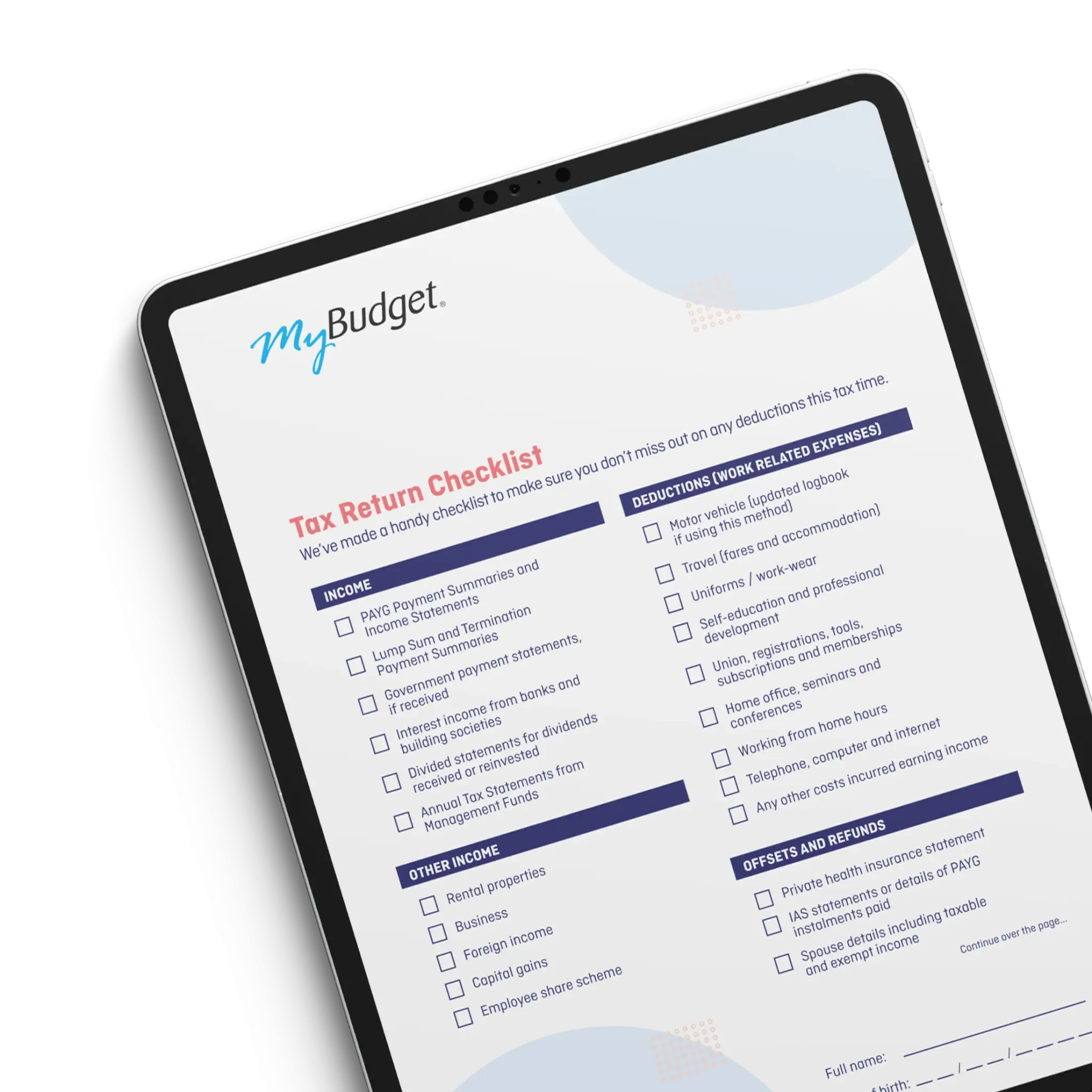
Our free downloadable Tax Return Checklist is designed to help jog your memory, organise your paperwork, and make tax time feel far less chaotic, whether you’re lodging your own return or working with a registered tax agent.
Before lodging your tax return, make sure you’ve gathered the right records and documents.
Common documents Australians forget at tax time
People often remember receipts, but forget smaller records that can still matter.
That might include:
- Bank interest statements
- Private health insurance statements
- Income protection insurance records
- Union fee records
- Professional memberships
- Dividend statements
- Managed fund distributions
- Charitable donation receipts.
Quick EOFY checklist
- Income statements and PAYG summaries
- Bank interest statements
- Rental property records
- Work-related expense receipts
- Vehicle logbooks
- Donation receipts
- Super contribution records
- Investment and share statements
- Work-from-home records and diaries.
What should you do with your tax refund?
According to Tammy Barton, many Australians unintentionally waste their tax refund because it feels like ‘extra’ money, when in reality, it can be one of the easiest opportunities to make meaningful financial progress.
If you’re lucky enough to receive a tax refund, it can be tempting to treat it like bonus spending money. But a tax refund can also be a powerful financial reset button.
Smart ways to use your tax refund
- Pay off expensive debt
Credit cards, personal loans and buy now, pay later balances can quietly chew through your budget. Using your refund here can create immediate breathing room. - Build an emergency fund
Even a modest buffer can help prevent future reliance on credit when life throws curveballs. - Get ahead on your mortgage
An extra repayment can reduce interest and improve long-term cash flow. - Boost long-term savings
Whether it’s future travel, school costs, car expenses or bigger financial goals, putting your refund to work can create momentum.
Treat your tax refund like a bonus. Don’t budget for it, and when it lands, use that lump sum to really set yourself up for lasting financial success.
Tammy Barton | MyBudget Founder & Director
Beyond tax time
Tax time can shine a spotlight on bigger money habits, from disorganisation and reactive spending to simply not having a system that helps you stay on top of things.
While MyBudget doesn’t prepare or lodge tax returns, we do help Australians get more organised with money, reduce financial stress, and build better budgeting habits all year round.
If tax time leaves you feeling overwhelmed, setting up a budget can make the rest of the year feel much easier.
FAQs about 25/26 Tax Returns
Can’t find what you’re looking for? See more FAQs…
No. MyBudget does not prepare or lodge tax returns. We provide educational resources and budgeting support, but your tax return should be lodged by you or a registered tax agent.
No. Many Australians with straightforward tax situations choose to lodge their own return through myTax. If your finances are more complex, a registered tax agent may be worth considering.
Some Australians may be able to claim limited work-related expenses, laundry costs, or cents-per-kilometre vehicle claims without formal receipts, but you still need evidence that you spent the money and how you calculated the claim.
In most cases, income earned from a side hustle must be declared to the ATO. Depending on the type of work, you may also be able to claim eligible business-related expenses.
This article has been prepared for information purposes only, and does not constitute personal financial advice. The information has been prepared without taking into account your personal objectives, financial situation or needs. Before acting on any information in this article you should consider the appropriateness of the information having regard to your objectives, financial situation and needs.